Port and Terminal Throughput: Why Marine Cargo Handling Must Become a Flow Discipline
Ports and terminals are no longer judged only by how much cargo they can handle in a year. They are judged by how predictably cargo moves through berths, cranes, yards, gates, rail connections, trucks, and customer handoffs. In a world of uneven trade flows, vessel schedule volatility, larger ships, labor constraints, and higher service expectations, terminal throughput has become an operating discipline.
For CEOs in marine cargo handling and transportation support activities, the burning platform is that port capacity can look adequate on paper while flow breaks down in practice. A berth may be available, a crane may be scheduled, and a yard may have space, yet cargo can still stall because labor, equipment, documentation, appointments, rail handoffs, and customer communication are not managed as one system.
Ports create value when cargo moves predictably; terminal bottlenecks turn vessel schedules, yard flow, labor, and equipment constraints into network risk.
Port Throughput Is a National Flow Constraint
The Bureau of Transportation Statistics’ 2026 Port Performance Freight Statistics Annual Report underscores how concentrated and consequential port flow has become. The report states that the top 25 container ports handled 39 million loaded TEUs in 2023, down 11% from 2022, with imports accounting for 63% of loaded TEUs. Los Angeles, New York and New Jersey, and Long Beach were the three largest container ports by loaded TEUs.
Those numbers show that a relatively small set of nodes shapes a large share of U.S. trade flow. They also show why terminal performance matters beyond the port fence. When marine cargo handling slows, the effects spread into trucking, rail, warehouse operations, inventory availability, production schedules, retail replenishment, and working capital.
BTS’s 2026 Port Performance program also maintains port profiles with measures such as vessel calls, vessel dwell times, commodities, and monthly container activity. That visibility reflects a broader reality: ports are not simply static infrastructure. They are live operating systems whose performance can be measured, compared, and improved.
The national importance of that flow is why terminal performance belongs on the CEO agenda. Marine cargo handling decisions affect carrier reliability, shipper working capital, drayage productivity, warehouse labor, customs timing, and inland distribution. A small change in terminal dwell or gate productivity can create a much larger effect across the customer’s supply chain.
Vessel Reliability Is Still an Operating Problem
Global vessel schedule reliability remains a major source of variability for terminals. Sea-Intelligence’s March 2026 Global Liner Performance analysis reported that global industry schedule reliability improved to 62.2%, the joint-highest figure for 2026 at the time, but the average delay for late vessel arrivals was still 5.48 days. A later April 2026 update reported schedule reliability at 62.4%, the highest level of the year, but still far from full predictability.
For marine terminals, a vessel that is several days late does not simply arrive late. It changes berth planning, crane assignments, labor deployment, yard density, rail cutoffs, truck appointments, equipment availability, and customer expectations. When multiple services bunch or blank sailings alter flows, the terminal can move quickly from planned workload to congestion.
The operating challenge is to build a terminal system that can absorb schedule variability without losing control. That requires scenario-based berth planning, labor flexibility, yard strategy, equipment readiness, rail and truck coordination, and clear escalation when the plan changes. The terminal cannot eliminate global vessel delay, but it can control how quickly it translates delay into a revised operating plan.
The terminal therefore needs a planning process that is resilient to imperfect upstream data. Estimated times of arrival, vessel rotations, crane programs, labor orders, rail cutoffs, and truck appointments must be reviewed as live assumptions rather than fixed plans. When the assumptions change, the plan has to change in a controlled way.
Yard Flow Determines Whether Capacity Is Real
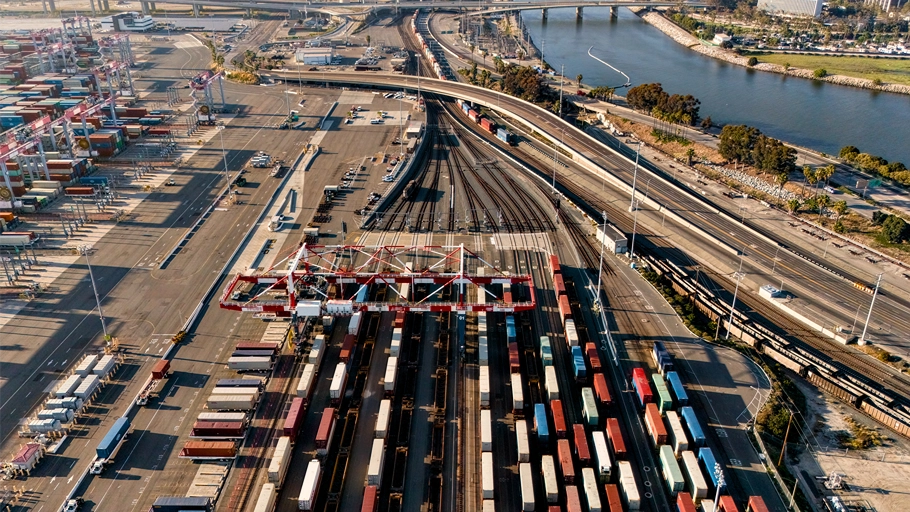
A port terminal can have physical capacity and still lack productive capacity. The constraint may be yard density, chassis availability, container location accuracy, crane sequence, truck gate queues, railcar availability, reefer plugs, empty-container handling, hazardous cargo segregation, or delayed customs and documentation. Capacity becomes real only when containers can move through the system without excessive rehandles, dwell, or exceptions.
Yard flow is especially important because it connects every other part of the terminal. Berth productivity suffers when containers are not staged correctly. Gate productivity falls when appointments are not matched to equipment and location. Rail performance weakens when blocks are incomplete or cutoffs are missed. Customers experience delays even when the terminal appears to have labor, cranes, and acreage.
CEOs should therefore require visibility into flow, not only throughput totals. Key questions include where containers dwell, why rehandles occur, which customers or lanes create avoidable complexity, where gate appointment discipline breaks down, and which bottlenecks are created by upstream vessel changes versus internal terminal execution.
Dwell reduction is often the most visible target, but dwell is usually a symptom. The deeper question is what caused the container to remain in the terminal: late pickup, missing documents, failed appointment, customs hold, chassis issue, rail delay, yard congestion, or customer behavior. Without that root-cause discipline, leaders may push cargo out faster in one area while creating congestion somewhere else.
Labor, Equipment, and Automation Must Be Sequenced
Marine cargo handling is labor- and equipment-intensive. Crane availability, yard tractors, top handlers, reach stackers, maintenance teams, clerks, gate staff, lashers, planners, and supervisors all determine whether the terminal converts vessel calls into cargo movement. If one critical resource is missing, the terminal’s effective capacity falls even when other assets are available.
Automation and modernization can improve throughput, safety, and visibility, but they do not remove the need for operating discipline. Reuters reported in February 2026 that Maersk’s APM Terminals and Eurogate planned a roughly $1.2 billion modernization of the Bremerhaven terminal to increase annual throughput capacity by one million TEUs. That kind of investment highlights the strategic importance of terminal productivity, but the value depends on execution: process design, workforce readiness, maintenance capability, data quality, and customer integration.
The practical issue for terminal CEOs is sequencing. Technology, labor agreements, equipment purchases, maintenance strategy, berth rules, yard design, and customer commitments must be implemented in a way that protects the live operation. A modernization program that disrupts flow without clear operating controls can erode the very capacity it is meant to create.
Customers Need Exception Visibility, Not Just Status Updates
Cargo owners, carriers, truckers, railroads, and forwarders all need to know more than whether a container is present. They need to know when cargo is likely to be available, what exception is preventing movement, who owns the next action, and whether the promised appointment, rail cutoff, or delivery window is still realistic.
This is where many terminal operations lose value. Visibility tools may show status, but the operating model may not assign ownership or resolution. A customer can see a delay without knowing whether it is caused by vessel arrival, inspection, yard location, equipment shortage, missing documents, rail connection, gate availability, or appointment failure. Information without action becomes frustration.
The strongest terminals will treat exception management as a product. That means clear codes, escalation paths, customer communication routines, and daily review of what caused delays. The goal is not merely to answer customer questions. It is to reduce the repeat exceptions that create congestion, cost, and service risk.
Exception visibility also has a commercial dimension. Customers are more likely to accept volatility when they trust that the terminal understands the cause, owns the next step, and communicates the impact early. When communication is late or vague, the same operational exception becomes a relationship problem and a potential revenue risk.
The Brooks International Perspective
From Brooks International’s perspective, marine cargo handling is a flow-management challenge. Port terminals sit at the intersection of ocean networks, inland transportation, labor, equipment, data, customers, and public infrastructure. When those elements are managed separately, the terminal becomes reactive. When they are managed as one system, the terminal can improve throughput and reliability without relying only on physical expansion.
The highest-value work is often practical and operational: improving berth planning, reducing yard rehandles, strengthening gate appointment discipline, aligning labor to vessel and yard plans, improving maintenance readiness, and giving leaders earlier visibility into bottlenecks. These improvements convert existing assets into more reliable capacity.
Brooks International helps leadership teams build the operating cadence, accountability structure, and performance visibility required to turn terminal complexity into controlled execution. For ports and marine cargo handlers, that means managing flow as the business model, not as a byproduct of volume.
What Infrastructure Leaders Should Be Asking Now
The leadership agenda should test whether terminal capacity is being managed as an end-to-end flow system.
• Where does cargo flow break down most often: berth, crane, yard, gate, rail, documentation, equipment, labor, or customer handoff?
• Can leaders see dwell, rehandles, gate performance, berth productivity, labor utilization, and equipment readiness in one cadence?
• How quickly does the operating plan change when vessels arrive late, services bunch, or customer demand shifts?
• Which customers, cargo types, or lanes create disproportionate complexity relative to revenue and margin?
• Are automation and equipment investments tied to measurable reductions in dwell, rehandles, congestion, and service exceptions?
• Does the terminal have a clear owner for each major exception category and a routine for preventing repeat failures?
The Leadership Imperative
Port capacity is becoming more than a capital planning question. It is a flow question. The terminals that perform best will be those that can translate vessel variability, yard pressure, labor constraints, equipment needs, and customer expectations into reliable daily execution.
For CEOs in port and marine cargo support activities, the mandate is clear: make terminal throughput a managed operating discipline. Physical assets matter, but predictable flow is what creates customer confidence, network reliability, and enterprise value.