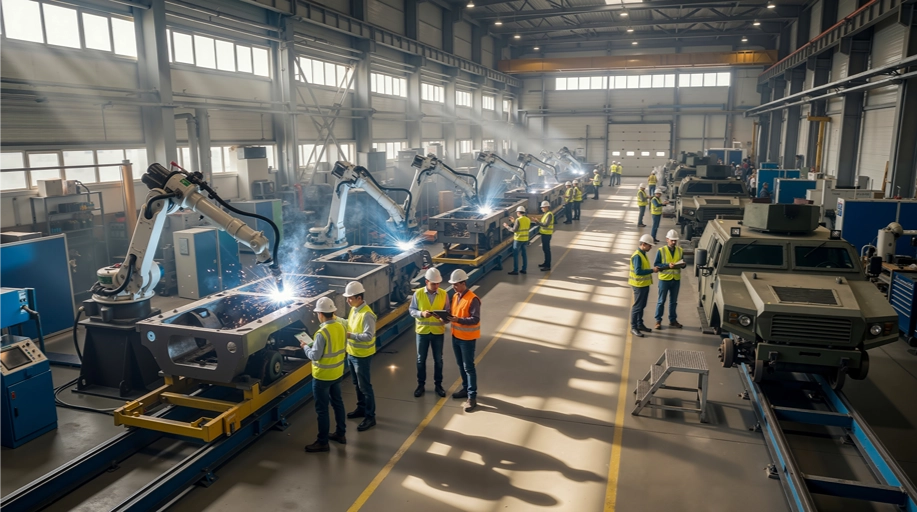
The Automation Divide: Why Smart Manufacturing Value Depends on Execution
Industrial manufacturers are entering a new phase of competition. AI, robotics, machine vision, digital twins, advanced analytics, connected equipment, and autonomous decision support are moving from boardroom ambition into the daily operating agenda of plants, supply chains, and service networks.
The strategic logic is clear. Manufacturers need more productivity, more capacity, more agility, and more resilience. Many also need to offset persistent labor constraints, rising input costs, regional supply-chain complexity, and customer expectations for faster delivery and tighter quality. Smart manufacturing is now being positioned as a core answer to all of these pressures.
The risk is that technology adoption is accelerating faster than operating capability. Manufacturers can invest heavily in automation and still fail to improve throughput, labor productivity, schedule adherence, quality, or unit cost if the technology is not connected to the way work is planned, supervised, measured, and controlled.
The automation winners will not simply be the companies that buy more technology. They will be the companies that turn technology into disciplined operating performance.
Automation Is Becoming a Competitive Divider
The gap between technology leaders and laggards is widening. PwC’s 2026 Global Industrial Manufacturing Sector Outlook reports that the median share of industrial manufacturers expecting highly automated processes by 2030 is projected to more than double, rising from 18% to 50%. Among “future-fit” industrial manufacturers, the share of highly automated processes is expected to rise from 29% to 65% by 2030.
Those figures point to a major shift in the basis of competition. Automation is no longer only a plant-level improvement initiative. It is becoming a strategic capability that affects margin, capacity, customer responsiveness, workforce productivity, and the ability to scale into adjacent revenue pools.
But the same trend also creates risk. As the technology curve steepens, companies that remain dependent on manual workarounds, fragmented systems, disconnected data, and reactive management routines will fall further behind. The issue is not only whether a manufacturer has adopted automation. It is whether the business has the operating model required to make automation produce measurable results.
Technology Is Not the Operating Model
Many manufacturers have already learned that the hard part of smart manufacturing is not buying the software, robots, sensors, or analytics tools. The hard part is changing how the business runs. Technology can surface constraints, identify defects, forecast failures, optimize schedules, and improve decision quality. But it does not automatically create accountability, supervisor follow-through, maintenance discipline, material readiness, or production stability.
Deloitte’s 2025 Smart Manufacturing and Operations study found that respondents reported up to 20% improvement in production output, 20% improvement in employee productivity, and 15% unlocked capacity from smart manufacturing initiatives. The same research also highlights the operational complexity, workforce gaps, cybersecurity concerns, and implementation challenges that manufacturers must manage to capture that value.
This is where many smart manufacturing programs stall. They produce dashboards, pilots, proof points, and isolated wins, but they do not become the daily management system of the enterprise. A predictive maintenance model does not improve uptime if planning and scheduling remain weak. A digital production board does not improve performance if supervisors do not use it to remove barriers. A robot cell does not improve labor productivity if material flow, quality standards, and staffing models are not redesigned around it.
The Workforce Must Be Redesigned Around Human-Technology Performance
The automation divide is not a story about replacing people. It is a story about redesigning work. As automation increases, manufacturers need different skills, different management routines, and different expectations for supervisors, maintenance technicians, engineers, planners, schedulers, operators, and quality teams.
This matters because the workforce problem is still real. The National Association of Manufacturers’ Q1 2026 outlook survey showed that 75.3% of manufacturers reported a positive outlook, but trade uncertainty, rising health care and insurance costs, and raw material costs remained top business challenges. In that environment, manufacturers cannot afford to add technology while leaving labor planning, training, cross-training, and front-line management unchanged.
The best automation programs make the workforce more effective. They reduce manual data collection, expose variation faster, support better preventive maintenance, improve setup discipline, and give supervisors clearer visibility into whether the shift is on plan. The weakest programs add complexity to already stretched teams and create another layer of tools that people are expected to manage without changing the system of work around them.
Scaling from Pilot to Enterprise Requires Standards
A common failure point is the handoff from successful pilot to enterprise-wide adoption. One site proves the concept, one line demonstrates improvement, or one team finds a way to make the tool work. But when the company attempts to scale, variation in data definitions, work processes, maintenance routines, operator training, and leadership expectations prevents the same result from being repeated.
Manufacturers need standards that make technology transferable. That includes common definitions of downtime, yield, labor utilization, first-pass quality, schedule adherence, and capacity. It also includes standard escalation paths, issue-resolution routines, and expectations for what leaders do when the system shows an abnormal condition.
The practical question for CEOs is whether the company is building a scalable operating capability or a series of local improvements. The first creates enterprise advantage. The second may create isolated wins, but it will not change the performance curve of the business.
The Brooks International Perspective
From Brooks International’s perspective, the automation divide is an execution divide. Manufacturers do not win because they deploy more technology. They win because they translate technology into stronger operating control.
That means connecting digital tools to the performance system of the plant and the enterprise. Production standards, labor models, maintenance routines, quality controls, material planning, supervisor cadence, and escalation paths all have to change when automation is introduced. Otherwise, the business risks automating pieces of a weak process rather than building a stronger one.
The highest-value opportunities are often found where the technology investment meets the management operating system: where production losses are identified but not acted upon, where maintenance alerts exist but work orders are not ready, where quality data is captured but not used to prevent defects, where labor is scheduled but not flexed to demand, and where executives can see results after the fact but not intervene early enough to change outcomes.
Brooks International helps industrial manufacturers close that gap by putting the structure, accountability, cadence, and control points in place to convert technology into operational and financial performance. The objective is not a smarter factory in concept. It is a factory that produces more reliably, uses labor more effectively, improves quality, reduces downtime, and protects margin.
What General Industrials & Manufacturing Leaders Should Be Asking Now
The immediate leadership agenda should focus on whether smart manufacturing is becoming an enterprise performance system or remaining a collection of disconnected initiatives:
- Where are automation and AI investments already producing measurable improvement in throughput, labor productivity, quality, schedule adherence, or unit cost?
- Which digital pilots have not scaled, and is the barrier technology, data quality, operating discipline, ownership, or front-line adoption?
- Are supervisors, planners, maintenance teams, and quality leaders using smart manufacturing outputs to make daily decisions, or are they treating them as reporting tools?
- Does the operating model define how people, processes, and technology work together at the shift, site, and enterprise level?
- Are automation investments changing the labor model, training requirements, maintenance routines, and material flow needed to capture the intended value?
- Can leaders see performance gaps early enough to intervene before downtime, rework, missed shipments, or cost overruns are already locked in?
The Leadership Imperative
The next phase of industrial manufacturing will reward companies that can combine technology adoption with execution discipline. The manufacturers that pull ahead will not only have better tools. They will have better operating systems.
For CEOs and boards, the mandate is to move beyond automation as a capital program and manage it as a performance agenda. Every smart manufacturing investment should have a clear link to the operating metrics that drive EBITDA, free cash flow, customer performance, and strategic flexibility.
The automation divide is widening. Manufacturers that build the structure to turn technology into daily execution will gain capacity, productivity, quality, and speed. Those that do not may discover that digital investment alone is not enough to change the trajectory of the business.